

Why are we so afraid of being perceived?
On a viral article and the questions it posits about privacy.

By now, you’ve probably read British Vogue’s viral article Please, Stop Telling Your Partner My Secrets by Hannah Ewens that resulted in some of the most rabid comment sections I’ve seen in a while.
In case you aren’t chronically online, the piece opens with an anecdote about Ewens’ friend Belle’s boyfriend who repeatedly mentions personal events in Ewens’ life that she’s never told him about. She writes: “Each time, it was disorientating to learn I had been discussed without my consent… why did this random man called Matt know anything about my inner life at all?”
Ewens is frustrated that it is considered “normal behaviour” for women to discuss their friends with their partners. When one of her friends suggests that they might do so to have a sounding board and process information in a safe environment with a trusted and neutral source, Ewens questions whether “intimacy with one person” should require “the sacrifice of another’s privacy”.
To me, that moral clincher, ‘I tell my partner everything’, sounds less like a declaration of closeness – and more like a compulsive habit.
Ewens frames women confiding in their partners as “disloyal”. She calls it a “betrayal” of their single friends, and this provides the premise for Ewen’s argument that women should stop confiding in their boyfriends/husbands about things their friends tell them, because this is an unfair, selfish and maybe even a betrayal of women as a collective. Of course, because this is the internet, the nuance regarding what the subject matter of the conversation is, how close the partner is to the friend, etc. is lacking.
The piece went viral in late February, and two weeks later, I’m still frustrated at a) how uncharitable it is to women in general and b) the wild generalisations it makes based off of one encounter.
Is it bad that she confided in him, or bad that he revealed that she had?
Ewens writes that confiding in partners is “a woman problem” (despite the fact that it is actually a man that made her uncomfortable) because women are insecure in their romantic relationships and share gossip with their boyfriends to “feel superior”.
This is somehow framed as an insightful comment about womanhood, instead of what it actually is: a sexist depiction of women as always in competition with one another and seeking to exploit each other’s misfortune.
This instinctively feels like a woman problem to me. We do it for security in our romantic relationships – there’s nothing I won’t tell you, no one I won’t betray for our bond – and we do it to feel superior, telling ourselves neither of us has that problem, at least not right now. We turn our friend into a character in a story, psychologically-enticing gossip, a discussion point to graze over. We remove their agency to present themselves and their problems, hopes and fears as they wish. But it is our responsibility to respect our friends, instead of this unconscious way of operating that only serves convention – and will certainly never serve us.
To me, this is an uncharitable, bad faith and, quite frankly, sad depiction of friendship based off of one example of one friend’s ex boyfriend’s social misstep. It operates on the presumption that friends only discuss us to pick us apart and feel better than us, when I don’t think this is true at all — if it was, why would you consider those people your friends? When I think of my own marriage and my friendships, there is a line between simply talking about someone, and sharing private/traumatic information about them that I know they would never want repeated. I would argue that the average friend knows where that line is, and if they fuck up, you should just tell them instead of assuming bad intentions.
But back to the story. What keeps me up at night is that the whole thing is predicated on the fact that it is Belle in the wrong when her boyfriend is the one who wildly missteps by assuming closeness to Ewens. I’ve scoured heated IG comment sections, asked my friends and followers alike, and even consulted with my husband (sorry!) and we all agree that it would be unacceptable if our partners behaved like this because it is a major faux pas.
This article blames a woman for a man overstepping boundaries, instead of calling him out for causing discomfort between his girlfriend and her friend simply because he didn’t know when to STFU. Why is Belle to blame for his social incompetency? Is it bad that she confided in him, or bad that he revealed that she had?
(And, side note, I think it’s interesting that a close friend’s boyfriend is referred to as “a random guy” despite the fact that he is around enough for his behaviour to be a repeat problem — but that’s a discussion for another day.)
Is gossip a “woman problem”, or is it necessary for a sense of community?
“Everybody wants a village, nobody wants to be a villager.”
This is perhaps an over-used quote on social media, but one I couldn’t help thinking of when I read Ewens’ article and puzzled over its frustration with her friends simply discussing her without her presence. (Not bitching! Not complaining! Just talking is problematic, it seems.)
Personally, this seems unreasonable to me. If you’re a part of someone’s life, chances are they will talk about you when you’re not around. This, to me, doesn’t necessitate gossip — being perceived is the trade-off you make for friendship and community. Yes, it’s vulnerable and uncomfortable, but I don’t think it makes sense to expect no one to talk about you ever. Excluding things that are explicitly off-limits, of course.
And then there’s the stigmatising of gossip.
Sure, sometimes gossip is nasty and mean-spirited, but more often than not it is a tool to negotiate morality, complex dilemmas and socially acceptable behaviour that we have been using for as long as society has existed. Gossip drives vicarious learning and facilitates social connection in friendships and, yes, in partnerships too. Talking with your partner about other people teaches them your values, expectations and opinions, as well as gives them insight into your inner life. When you tell them about something that happened with a friend, you are not only sharing your own experience but vicariously learning what you or your partner would do in that situation, and that helps you understand them and your relationship better. It’s why we’re so obsessed with celebrity drama and reality TV — they act as a canvas for us to figure out what we believe is okay and not okay, and by talking about it, we communicate our own boundaries and expectations.
Interestingly, Ewens acknowledges this. She writes: “Once, years ago, I told a boyfriend that my friend had cheated on her partner. I shared this mostly in a bid to make sense of my conflicting feelings about this information.”
Here, she’s identified that the why of gossip/talking usually stems from a need to process information with someone else who can either affirm or challenge your beliefs, depending on how you feel and what you need — and I say need because yes, sometimes you need to process externally. It helps you identify a social expectation you may not be aligned on and fosters closeness by exchanging information that isn’t public. This last part is crucial for understanding why it’s associated with women — we’re the ones who historically have relied on private communication to circumvent exclusion from the public sphere.
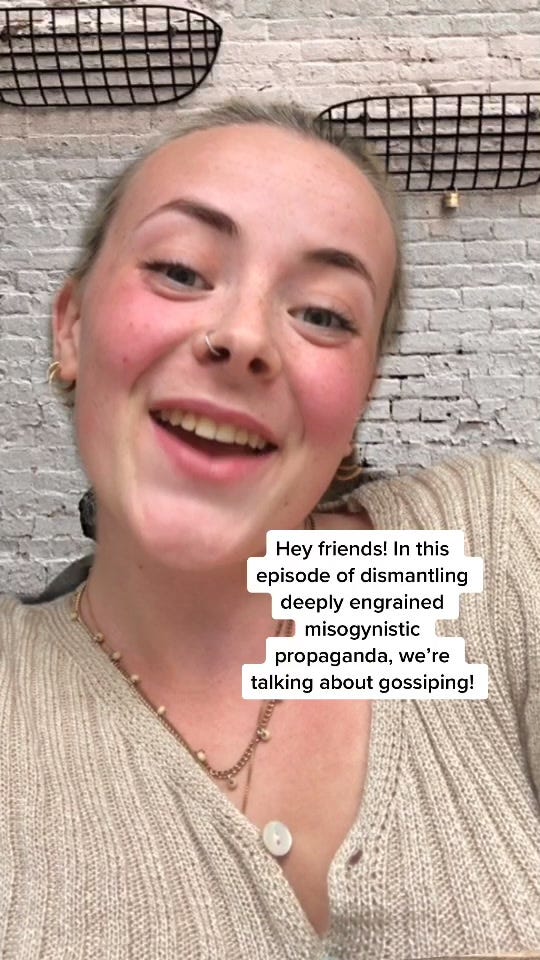
 Tiktok failed to load.
Enable 3rd party cookies or use another browser
Ewen writes off gossip as a “woman problem” because of women’s apparent insecurities around men, but gossip has also historically been a tool for women to protect each other from men. It’s how we warn each other of men who might be violent, abusive or dishonest. By sharing stories, we paint a picture of who someone is.
I’m always suspicious of suggestions that gossip is bad on the grounds of “privacy” simply because this echoes the talking points abusers use when they shut down allegations by claiming the incident is a “private matter” to be dealt with at home. In fact, I think we should problematise “privacy” as a concept and ask ourselves what we really mean when we refer to it. Sure, everyone is entitled to a certain level of privacy. But we’re also all part of a vast, nebulous network of of friendships, relationships and acquaintances that exist alongside us in our own little village. If you want to be able to talk to your friends about other people, you have to accept that they might also talk about you.
Ewens concludes her article by quoting Belle, the OG friend, who shares that her new boyfriend hates it when she gossips with him:
She gave me her best impression of him over a flat white, manly but withering: “He says, ‘I don’t think so-and-so would like you telling me that. And anyway – I don’t care and don’t want to hear about it’.
The purpose of this anecdote is to illustrate that you don’t have to tell your partner everything, but to me all it does is show that Belle’s latest boyfriend is an asshole. Where is the interest in her emotions, feelings and daily happenings? Why are you shutting down your girlfriend when she wants to share something with you? And, more importantly, why are we centring what a man thinks of gossiping when men are suffering from their own loneliness crisis precisely because they don’t talk about what is happening in their lives?
So, to clarify, yes, it is completely reasonable and fair to want the personal information you share with your friend to stay private. I don’t disagree with this element of the article’s argument.
But to demonise women talking to their boyfriends/husbands about something that hasn’t been declared as confidential seems, at best, unfair, and, at worst, a sign of our increasingly conservative and individualistic times.
The idea that “intimacy with one person requires sacrificing another’s privacy” feels overly absolutist. There’s a spectrum between sharing context and violating confidence. Most adults understand that distinction. Treating women as incapable of navigating it feels reductive.